On Living a Symbolic Life
Earlier this week, I took the train to Roermond to visit Het Oude Kerkhof, one of the oldest cemeteries in the Netherlands. I was feeling restless and needed a walk.
Heading southeast of the train tracks, along Kapellerlaan Avenue, I stopped to admire the views of the River Roer and the Neo-Renaissance and Art Nouveau villas with their generous front gardens. Although I’ve been to Roermond before, I had never been east of the train tracks before.
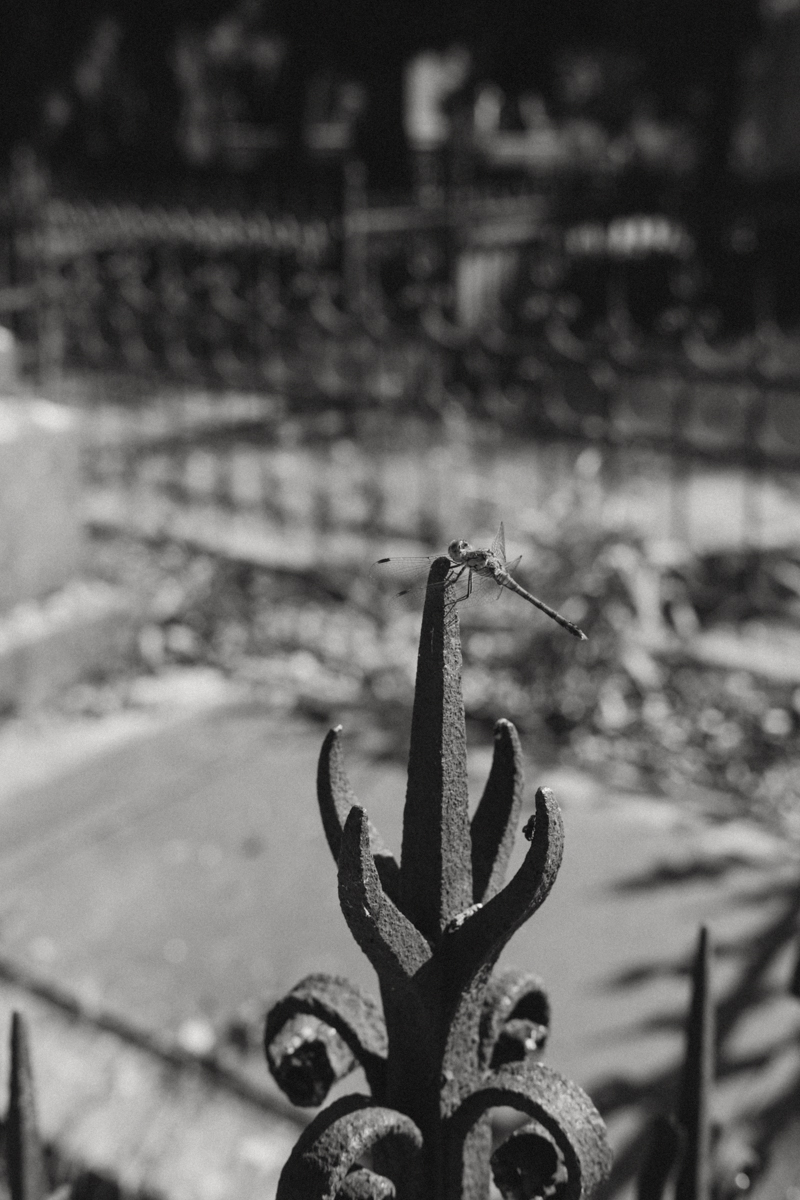
Once through the cemetery gates, I turned left, adjusted myself to my surroundings and slowed my pace.I looked around and saw that I wasn’t alone. There were some men in the far corner of the cemetery working on several grave sites. I noticed the size of the trees and how neat the grounds were. And when I began wandering again, I noticed the dragonfly resting in the sunlight on the edge of a wrought-iron fence.
Hmm, that’s strange, I thought to myself.
I’m used to seeing dragonflies darting back and forth near water, with their speed making them almost impossible to photograph. This dragonfly was a bit larger and, as I got close to it, it flew off for just a moment but then returned and allowed me to get close with my camera.
I thought it was odd and interesting but then dismissed it until I saw it again in another part of the cemetery. This time it was darting around a bush of flowers.
There must be many, I thought.
And I continued on my way.
By this point I had reached the southeastern most part of the cemetery, where I noticed the intricate iron crosses. One in particular, standing in dark shade, caught my attention.
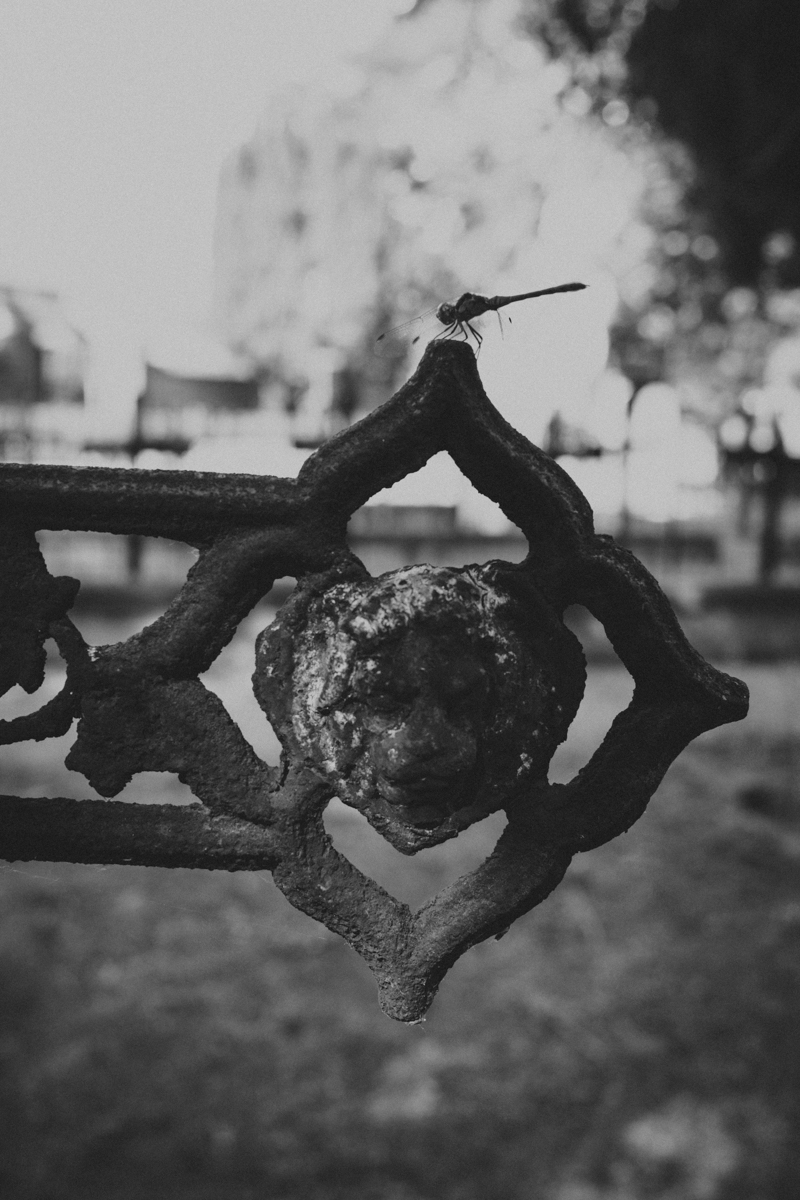
From where I was standing, I could see that the left and right sides of the cross bore the faces of a bull and a lion respectively. I snapped several photos as I walked toward it, trying to catch the sunlight against their faces. But I then noticed something else—there, on the edge of the iron cross, resting in the darkness, was the dragonfly. The glint of sunlight catching only the edges of its wings.
I stood there for a moment, transfixed.
The first time I dismissed it. The second time I dismissed it. But the third time, I recognized that it might be the symbol I had been waiting for for quite some time. Otherwise, why would it put so much effort into making making sure I noticed it?
Like way markers on a pilgrim’s journey, the dragonfly now stood alongside the symbol of the stairs, the ground, the veil of water, the pomegranate, the lighthouse, and the unexpected invitation.
Each one was a point of orientation for me where the visible world and my inner life briefly touched, confirming that I was still on the right path.
What brought me to the threshold was a sudden disillusionment with the life I had been living.
A life in which I was married to a man so abusive, I was lucky to escape alive. In which, prior to him, I had dated a narcissist who, in the end, openly admitted this to be the reason he could never really love me or anyone else. I had given up so much for so little and wanted to know why. What blinded me completely that I couldn’t see either of them for what they were? What beliefs about myself made these encounters possible?
And just like that, my desire to know the answers to these questions propelled me on an inner journey that, looking back now, has taken me about nine years to complete.
The moment I choose the road between two points, strange things begin to happen. Right from the beginning II refused to accept the obvious and knew that if I wanted a new life to emerge, I needed to move past the easy answers and my assumptions, and put all my trust into not knowing.
Symbols began to appear like knots on a rope and I began to live, what felt like, this strange double life.
On the surface I went about my routines and slowly began putting my life in order. But beneath the surface I played the detective, piecing together the clues, arriving at answers that only raised more questions, doing the work I intuitively knew I had to do.
I approached each symbol as if it were alive. I sought its meaning through relationship, treating it as a companion. I learnt that if the image is held as a true symbol—an expression of something fundamentally mysterious and not yet fully known—it continues to reveal new layers of meaning, driving the process of individuation forward.
However, not every striking coincidence or image is a message. As per Jung, the healthiest attitude to a symbol is one of curiosity rather than certainty. A symbol should be approached as a question before it becomes an answer. Its significance is confirmed not by how extraordinary it seems, but by whether sustained engagement with it leads to greater insight, integration, and psychological growth.
When I had reached the end of my journey, I knew it was the end because I had undergone a significant transformation, both emotionally and psychologically.
The earth beneath my feet stabilized. I had remarried. Started a new career. It felt like the end because, not only had a new life emerged, but also a new way of seeing. But I was still unsure if this was indeed the end or if more work needed to be done.
And this wasn’t something I felt I could decide. By now I had learned that the inner path had a life of its own and I knew there would be a sign that I had arrived at the end in the way of a symbol. I had only to wait for it.
So I waited for it, patiently.
The creature we recognize and admire as a dragonfly represents only a small portion of its existence. The majority of its life unfolds in a completely different element, unseen beneath the surface.
They undergo an extraordinary transformation. Unlike butterflies, dragonflies don’t form a chrysalis. Instead they climb out of the water, anchor themselves to a reed or branch, split open their old skin, slowly pull themselves free, pump fluid into their wings, and wait until they harden before taking flight.
They belong to two worlds.
Few creatures inhabit such different environments. As nymphs they breathe underwater through gills. As adults they emerge into the open air, their vision and body adapted to an entirely different way of being.
They don’t destroy their former selves; they leave the empty shell behind.
What image, place, or experience keeps returning to you?
x Martina